Back to School Vocabulary Word Search Pu
Integrating educational tools into daily routines requires more than just selecting a random activity; it demands strategic alignment with learning objectives and engagement levels. The Back to School Vocabulary Word Search Pu represents a specific intersection of cognitive training and seasonal transition, designed to bridge the gap between summer relaxation and academic rigor. For educators, parents, and content creators looking to streamline their preparation for the new school year, understanding how this toolkit fits into broader instructional workflows is essential. It is not merely a pastime but a structured mechanism for vocabulary retention, spelling reinforcement, and mental agility.
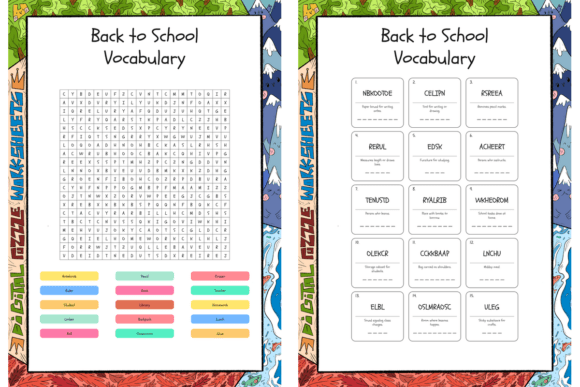
This gaming toolkit encompasses word search puzzles, scrambles, and crossword puzzles, each serving a distinct function in the learning process. When viewed through the lens of workflow optimization, these activities are not isolated events but components of a larger strategy to keep young minds sharp. By analyzing how these elements interact with different age groups and learning styles, professionals can better implement resources that foster both academic success and a genuine love for learning.
Understanding the Toolkit’s Role in Educational Workflows
The Back to School Vocabulary Word Search Pu is best understood as a modular resource within a teacher’s or parent’s planning cycle. In the context of back-to-school preparations, time is often fragmented, and attention spans can be volatile after a long break. This toolkit addresses two critical challenges: maintaining cognitive momentum and introducing new vocabulary in a low-stakes environment. Unlike traditional rote memorization, which can feel tedious and disconnected from real-world application, puzzle-based learning leverages pattern recognition and problem-solving skills.
For professionals such as curriculum designers or homeschooling parents, the value lies in the versatility of the format. A single resource pack can serve multiple purposes throughout the day. It can act as a warm-up exercise to transition students from passive leisure to active focus, a reward mechanism for completing core tasks, or an independent station activity during differentiated instruction periods. Recognizing these use cases allows for more efficient lesson planning, reducing the need to create disparate materials from scratch.
Pre-Implementation Planning and Preparation
Before deploying the Back to School Vocabulary Word Search Pu, effective integration begins with preparation. The quality of the outcome depends heavily on how well the activity aligns with the learner’s current proficiency level. For younger children, the word lists should focus on high-frequency terms and foundational concepts relevant to their grade level. For older students, the vocabulary can expand to include subject-specific terminology from science, history, or literature.
Organizational efficiency is key here. Educators should categorize the puzzles by difficulty and theme before distribution. This ensures that when a student finishes one task quickly, there is a logically sequenced next step available without requiring immediate adult intervention. Furthermore, preparing answer keys and tracking sheets in advance streamlines the assessment process. This proactive approach minimizes downtime and maintains the flow of the classroom or home study environment.
Strategic Implementation Across Different Contexts
The true utility of this toolkit emerges when it is applied consistently across various phases of the school year. During the initial weeks of school, the primary goal is often re-establishing routines and assessing baseline knowledge. Here, the word search and scramble activities serve as diagnostic tools disguised as games. They reveal which students struggle with letter recognition, which excel at pattern matching, and who might need additional support in spelling conventions.
- Morning Routine Integration: Use the puzzles as a "do now" activity. As students arrive, they engage with a quick word search, allowing them to settle in while activating their brains for the day’s lessons.
- Transition Periods: Utilize the scrambles during short breaks between major subjects. These require intense focus but less physical movement, making them ideal for calming a restless class.
- Enrichment Activities: For advanced learners, the crossword puzzles can be used to deepen understanding of complex terms, encouraging them to look up definitions and contextualize words beyond simple spelling.
By embedding these activities into existing schedules, educators reduce the friction associated with switching tasks. The familiar structure of a game provides a psychological safety net, making the return to academic work feel less abrupt and more natural.
Enhancing Cognitive Skills Through Interactive Design
The Back to School Vocabulary Word Search Pu is infused with fun, but its design principles are rooted in cognitive science. Word searches enhance visual scanning and sustained attention. Scrambles challenge working memory and phonological awareness, forcing the brain to manipulate sounds and letters simultaneously. Crosswords, meanwhile, integrate semantic knowledge with spelling, requiring users to recall meanings alongside orthographic rules.
For creators and publishers developing educational content, these distinctions matter. Understanding which skill set each puzzle targets allows for the creation of balanced curricula. Instead of relying solely on reading comprehension tests, a diversified approach ensures that multiple neural pathways are engaged. This variety keeps kids productively engaged, preventing burnout and boredom, which are common pitfalls in early education.
Moreover, the social aspect of these puzzles should not be overlooked. While often done individually, they can be adapted for collaborative work. Pairing students to solve a crossword together fosters communication and peer teaching. This interaction builds community among classmates, easing the social anxieties that often accompany the start of a new school year.
Quality Control and Long-Term Usability
When evaluating or implementing the Back to School Vocabulary Word Search Pu, consistency and accuracy are paramount. Errors in word placement or incorrect answers can undermine trust and frustrate learners. For digital implementations, ensuring compatibility across devices—tablets, desktops, and mobile phones—is crucial for accessibility. For print versions, clarity of font and spacing affects usability, especially for younger readers.
Long-term use also depends on the scalability of the content. A one-time activity loses its impact quickly. Therefore, the toolkit should be part of a recurring series. Regular exposure to vocabulary in varied contexts reinforces retention. Educators can track progress over time, noting improvements in speed and accuracy, which provides tangible evidence of growth for parents and administrators.
Additionally, consider the aesthetic and structural integrity of the materials. Visually appealing designs capture interest, while sturdy formatting ensures durability if printed repeatedly. For freelancers and bloggers reviewing such products, highlighting these practical aspects helps audiences make informed decisions about their investment of time and resources.
Integration with Broader Learning Ecosystems
No educational tool exists in a vacuum. The Back to School Vocabulary Word Search Pu works best when integrated with other learning platforms and methods. For instance, teachers can link the vocabulary words found in the puzzles to upcoming reading assignments or science units. This creates a cohesive learning narrative where discrete facts are connected to broader themes.
Parents can extend the learning at home by discussing the words discovered during puzzle solving. Asking open-ended questions like, "How would you use this word in a sentence?" transforms a solitary activity into a dialogue. This interaction deepens comprehension and demonstrates the practical application of language skills.
For marketers and educators promoting these resources, emphasizing this interconnectedness is vital. Positioning the toolkit not as a standalone product but as a catalyst for deeper engagement helps justify its inclusion in comprehensive educational plans. It becomes a reliable component in the ecosystem of tools used to nurture a child’s intellectual development.
Conclusion: Sowing Seeds for Academic Success
The journey through the school year is a marathon, not a sprint. Starting with a vibrant jolt sets the tone for the months ahead. The Back to School Vocabulary Word Search Pu offers a proven, engaging method to kickstart this journey. By combining entertainment with education, it reduces resistance to learning and builds confidence in young students.
For those responsible for guiding these young minds, the key is intentional implementation. Plan strategically, prepare thoroughly, and integrate seamlessly into daily routines. By doing so, you sow the seeds of academic success, fostering a love for learning that extends far beyond the first week of school. This interactive vocabulary gaming toolkit is more than just a puzzle; it is a foundation for lifelong curiosity and competence.